Slouching toward Jeopardy!, part 3

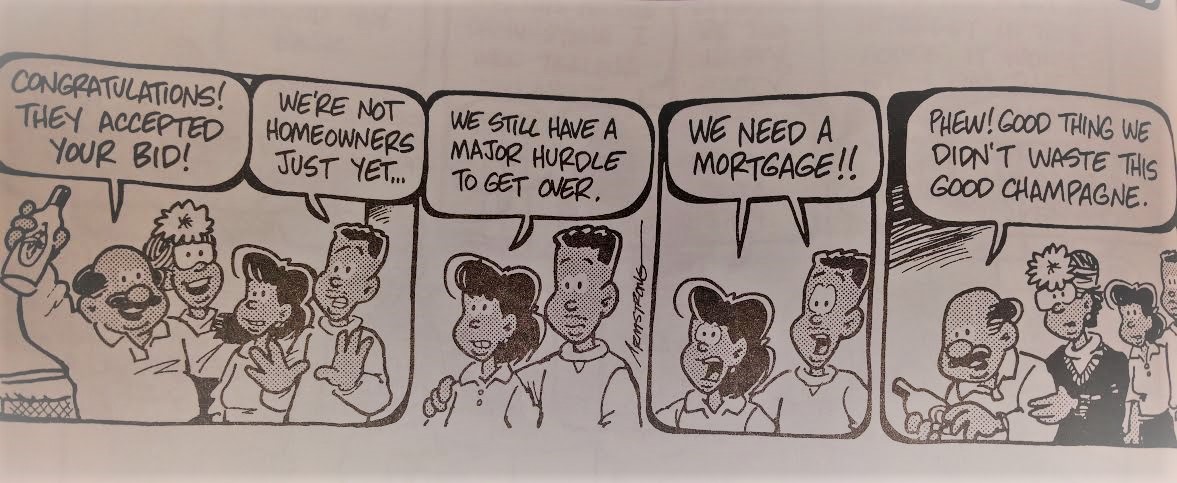
I assumed you would take it for granted that in addition to being a scavenger of books, I was also a fairly obsessive and indiscriminate reader.  In these days of concern about fake news, I look ruefully upon my younger self, and even my not-so-young self, for her willingness to learn about How Life Works by reading.  I mean, reading is a great way to get information, of course.  But I’m talking about reading for information to the point of getting life advice from comic strips.  Seriously, I can’t tell you how often, in the throes of some grown-up predicament, I flash back to a comic strip.  I’m pretty sure I learned about income taxes, driver’s tests, and mortgages from comic strips.

comic strip about getting a mortgage

“Jump Start” by Robb Armstrong

Reading indiscriminately, though, you sure do pick up a lot of information, quite a lot of which is not obviously useful and some of which isn’t even particularly interesting.  Meanwhile, the rest of life goes on, and you probably miss some of it because you’ve got your nose stuck in a book, probably a fairly irrelevant book like a 1978 travel guide to Eastern Europe or an Erma Bombeck collection–I read her entire oeuvre up to about 1980 at my grandmother’s house.

Whenever my sister remembers something from our childhood that I don’t, I say, “Where was I?” and she says, “In your room, reading.”


Posted in Jeopardy! | Comments Off on Slouching toward Jeopardy!, part 3

A Newborn Girl at Passover

When Yael, the daughter of my friends Lisa and Aaron, was born, I wrote this poem for her.  She celebrates her twentieth birthday at the end of Passover this year.

“A Newborn Girl at Passover” at the Academy of American Poets

To those who celebrate, chag sameach Pesach!

Posted in Uncategorized | Comments Off on A Newborn Girl at Passover

Slouching toward Jeopardy!, part 2

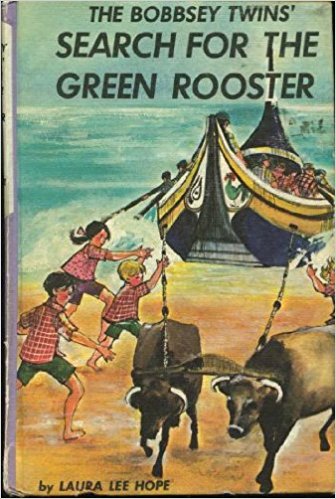
cover of the Bobbsey Twins' Search for the Green Rooster

Featuring some useful facts about Portugal.

Whenever I read applications for poetry-related things–fellowships, residencies, academic programs–there are personal statements that begin by invoking the childhood roots of the writer’s connection to books, literature, reading or writing, e.g., “Ever since I learned to read at age three…” or “I have loved books my entire life.”  While these are rarely the most persuasive personal statements, they always remind me that we all have personal myths around our obsessions, even if some of us are too sophisticated to share them.  Either we have loved books our entire lives, which is one kind of myth, or we began loving them at a particular moment, which is another–perhaps a conversion story; meeting Harry Potter on the road to Damascus, if you will.

With trivia people, it’s usually that we have always been collectors and retainers of information.  Some of us have truly astounding capabilities with regard to learning, storage, and retrieval, but since most kids are interested in collecting something–I liked owls and bottlecaps–and kids who don’t have too much difficulty with reading often find themselves collecting large amounts of facts and information as well (these weren’t really around when I was young, but they’re everywhere now), a lot of us just carry on with the childhood habit of collecting and not discarding what we learn.  My husband still has a lot of 1970s-era dinosaur lore (and has kept up with some advances in paleontology) and can identify a startling number of shark species.

I didn’t have the focused obsessions that he and lots of other kids had, though. I wasn’t necessarily in search of particular prey; I was more of a reading scavenger.  Books weren’t scarce in my world, but what seems important as I look back is that they came to me in a lot of different ways.  I had books of my own, books in my elementary classroom libraries and school library, but I also had my parents’ bookshelves and their coffee-table books and the books at my aunt’s apartment and at my grandmother’s house.  My mother ran an antique shop for a few years of my childhood and bought books in auction lots; I also went with her to other antique shops and browsed the book sections, which were always more interesting to me than furniture or glass.

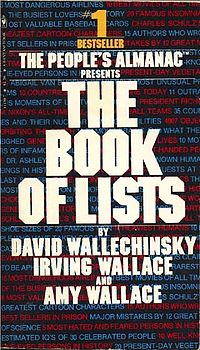
Cover of The Book of Lists

Wow, did I love this book.

When you read this way as a child, you come across all sorts of information and have no way of knowing that most of what you read is nearly completely irrelevant to your life.  I still can’t tell, to be honest.  The problem is that I don’t retain as much as I used to–and, in my adult life, with so much of my reading on the Internet, I can’t always remember where or in what context I learned some half-remembered thing.  It was different when books were so much more closely tied to specific places and even times for me.  I remember reading The Peterkin Papers in the wonderful loft in my elementary school library and The Book of Lists at my aunt’s house in Atlanta.

Reading books from those auction lots, in particular, gave me a passing acquaintance with names that were unfamiliar to other children and even adults.  There always seemed to be one of Bennett Cerf’s compilations of funny stories, hardcover books featuring celebrities of other generations, like the wits of the Algonquin Round Table.  (I probably would have found Dorothy Parker on my own, but it was definitely from those auction boxes that I also became a Robert Benchley fan.)  I think it was from one of Cerf’s books that I learned some quip that I parroted to my parents, attributing it to G.K. Chesterton, a name that sounded to them as if I had made it up.

Posted in Jeopardy! | Comments Off on Slouching toward Jeopardy!, part 2

Slouching toward Jeopardy!, part 1

Over the last few years, I’ve consumed a lot of the small subgenre of online writing that is Jeopardy! contestant narratives. Josh Fruhlinger, the writer of the indispensable Comics Curmudgeon blog, observes in his own writeup, “There seems to be some kind of rule that if you go on Jeopardy, you write about it on the Internet.”  Thank goodness for that; I might never have ended up on the show at all except that when I got serious about trying to get on, I wanted, like any other nerd, to read about the experience before having it.  Now I’ve had it, so, if you want to, you can read about mine.

I’m going to do this in a series of short (I think) blog posts leading up to the beginning of the 2017 Teachers Tournament, a month from now, and running through the tournament itself, May 8-19.  I won’t be able to talk about game specifics until after the tournament games air, but it feels as if I have plenty to talk about before then.  My family, friends, and colleagues could certainly tell you that I had a lot to say about the experience of preparing for the show long before I ever got to the studio.  In fact, some of them might be enjoying the respite from Jeopardy! prep talk that has ensued since I got back from taping.  (The ones who attended the taping, however, get to hear me rehashing the experience, something that probably won’t stop for a while.)

So, please, follow along.

Posted in Jeopardy! | Comments Off on Slouching toward Jeopardy!, part 1

Book giveaway winner

The winner of the book giveaway, chosen at random from among all eligible entries*, is Cantor Sarah Sager of Anshe Chesed Fairmount Temple in Beachwood, Ohio.  She was nominated by Kathleen Gisser, who cited Cantor Sager as her family’s “favorite clergy for three generations.”  Her book is on the way!

All of the nominations were wonderful.  I wanted to send everyone a book!  Thanks to those who took the time to tell me about their nominees and their love for poetry.

*All of the entries were eligible, as it turned out.  I just thought it was wise to give myself an out in case someone nominated, you know, this guy.

Posted in Unfinished City | Comments Off on Book giveaway winner

Spring break

I just read Philip Nel’s blog post on Kieran Setiya’s “The Midlife Crisis” (pointed there by a guest post on the late Alison Piepmeier’s blog, but that’s another story), with its distinction between telic and atelic activities (those with an endpoint or goal and those that do not aim for a completion or accomplishment).  Setiya proposes that to avoid or treat a midlife crisis, one can “invest more deeply in atelic ends,” the ones that may give most meaning to life (I think of relationships, friendships, nurturing other people, teaching; also practicing art or learning almost anything).  He says that we do not have to abandon telic activities, but can also shift our relationship to them; Nel writes,

Just pursue them for their own sake instead of for the end product: “Instead of spending time with friends in order to complete a shared project […,] one pursues a common project in order to spend time with friends” (15). As Setiya advises, “Do not work only to solve this problem or discover that truth, as if the tasks you complete are all that matter; solve the problem or seek the truth in order to be at work” (15).

I realized that sometimes, particularly on breaks, I take an atelic pursuit, like spending time with a friend, and approach it in a telic manner so that I can “accomplish” something like “Take a walk with Mary and her dog” or “Have a date with Matt.”  I’ve always been a little uncomfortable to find myself treating relationships like items on a to-do list, but it’s felt as though I’ve needed to approach them as telic so that I save some of my precious time for them and don’t let it get gobbled up by other tasks.  (I know I’m not the only one who’s vaguely embarrassed by the whole idea of “date night,” yet who’s perfectly aware that without the concept we could easily go months without venturing out of the house together.)

On the other hand, since I spend a lot of my time teaching, preparing to teach, reading and writing, it’s also true that even immersed in apparently telic activities (create a plan for Wednesday’s class, put this troubled poem draft through another revision), I am also engaged in atelic pursuits (increasing student engagement, continuing to learn how to write a poem).

I guess the next thing is to read the article itself–a telic activity in that I can read it from beginning to end, but in service of an atelic pursuit–figuring out how to think about life.  Nel says that the key factor is where you locate meaning in your life–in the accomplishment of particular goals, or in the continuing engagement with an activity for its own sake?  I would think and hope that it’s more the latter for me, but that doesn’t acknowledge the importance of some particular goals (finish my next book, pay for a child’s college, help this particular batch of students develop their own perspectives on Song of Solomon).

This feels like just the right thing to have read three-quarters through spring break, with the rest of the school year bearing down and summer to plan for.

Posted in good reads, life in general | Comments Off on Spring break

Book giveaway: for clergy and clergy-in-training (deadline April 3)

Oprah gift memeI’d like to send a copy of Unfinished City to someone who serves as a religious leader, or who is preparing to become one, in any tradition that takes the Torah as a significant text (i.e., any flavor of Judaism, Islam, Christianity, the Bahá’í Faith–go ahead and school me, I’m learning new things all the time).

Any rabbi, imam, priest, pastor, hazzan, youth minister, mullah, Bible study group leader, chaplain, etc., is eligible, as is anyone enrolled in a course of study to assume one of these roles or a similar one.  Feel free to nominate yourself if that describes you!

If you’ll share with me a few sentences about why you’d like this person to have a copy of Unfinished City,  I will read all of your responses and do a random drawing from all of the eligible ones received by Sunday, April 3.  I’ll then follow up with the winner’s nominator to get the appropriate contact information.  (You don’t need to share your nominee’s contact info as part of the nomination, but I may quote anonymously from your responses, unless you specifically tell me not to.)

Use the contact form below for your nomination.  Thanks, and good luck!

Go back

Your message has been sent

Warning
Warning
Warning

Warning.

Posted in books, Unfinished City | Comments Off on Book giveaway: for clergy and clergy-in-training (deadline April 3)

“What writers really do when they write”

Reading this piece by George Saunders in the Guardian about how writers feel their way toward what they didn’t consciously know they meant to write is like reading a poem or a novel and coming across one of those luminous, heartbreaking lines that tells you something you always knew and only now recognize.  I want to paste the entire thing into my commonplace book, but if I could only put in one line, it might be Einstein’s: “No worthy problem is ever solved in the plane of its original conception.”


Posted in writing | Comments Off on “What writers really do when they write”

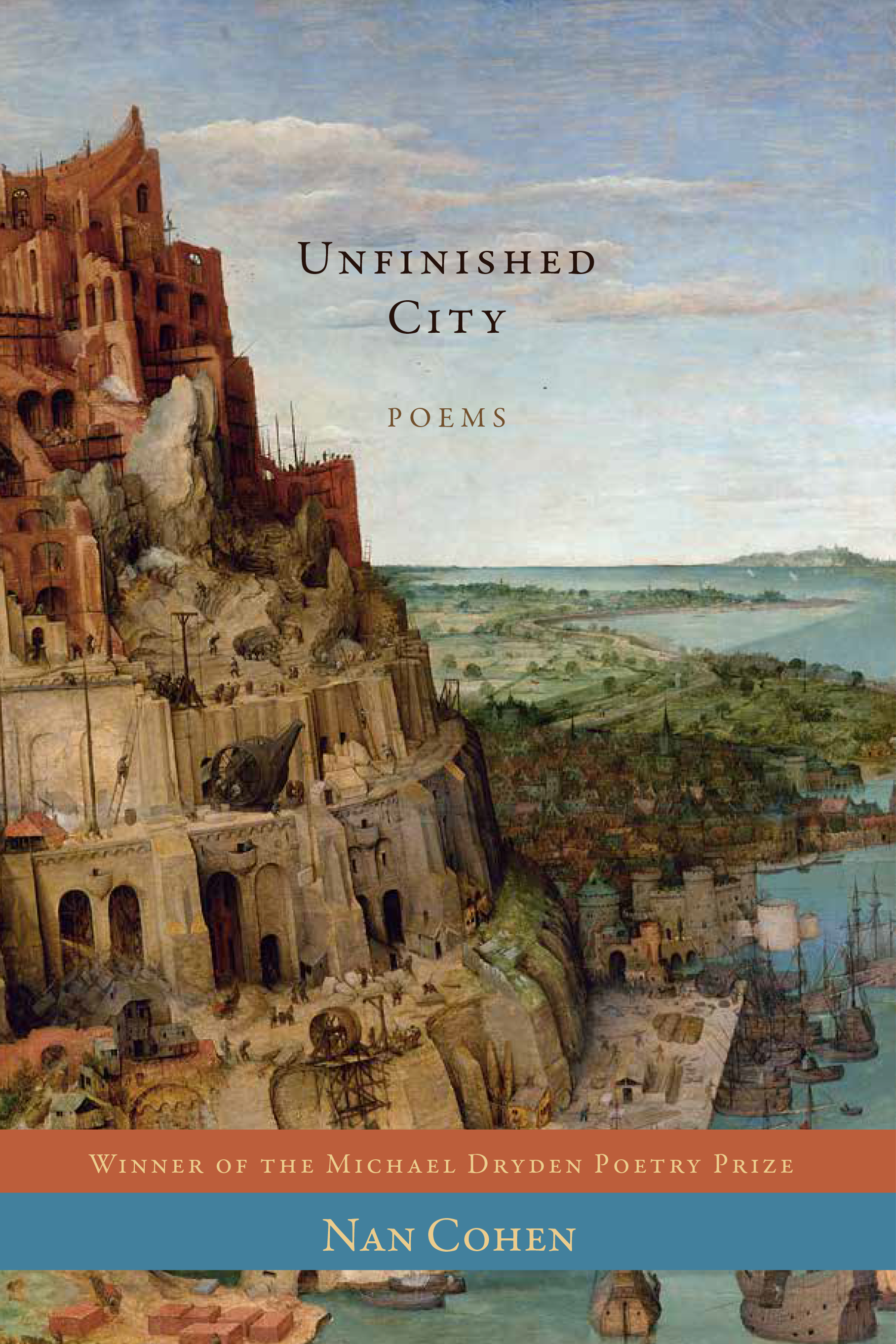
I keep staring at this cover the way you stare at a newborn baby

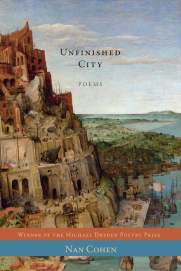
Cover of Unfinished City, poems by Nan Cohen.


And I’m so thrilled to be working with Gunpowder Press, whose books are so thoughtfully selected and edited, as well as so beautifully produced.  I love the story of how they got started; I knew the late David Allen Case (we overlapped in the graduate English program at UCLA) and am moved that the press came into being in part to bring The Tarnation of Faust into print.

The book is now available for pre-order and will be released on March 1.

Posted in Unfinished City | Comments Off on I keep staring at this cover the way you stare at a newborn baby

Renga for Obama

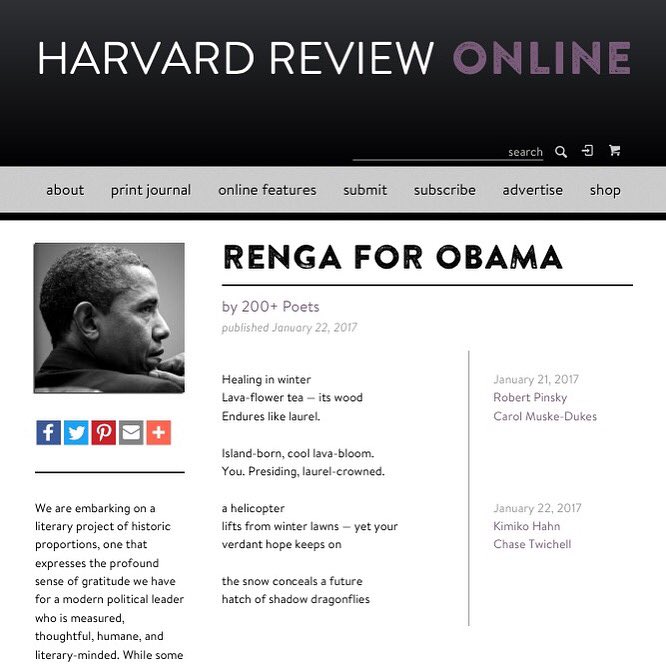
rengaThe Harvard Review is hosting a celebratory “Renga for Obama” on the conclusion of our 44th president’s second term.  A renga is a Japanese collaborative form consisting of linked stanzas composed in pairs.  A new pair of stanzas appears each day—a traditional haiku(which many of us know in English as a three-line syllabic form of 5-7-5 syllables) followed by a waki (a two-line stanza of 7 syllables each) that responds, elaborates on, or turns the haiku.  Today’s addition is a collaboration between Vermont poet laureate Sydney Lea and me.  He wrote today’s haiku, and I wrote the waki.  This project involves over 200 poets and will continue over more than 100 days.  Please follow along if you are so inclined!

Posted in poems, poetry | Comments Off on Renga for Obama